Preprint · 2026
Dependence Is Not Advantage: What Randomizing the Graph Does Not Measure
Abstract
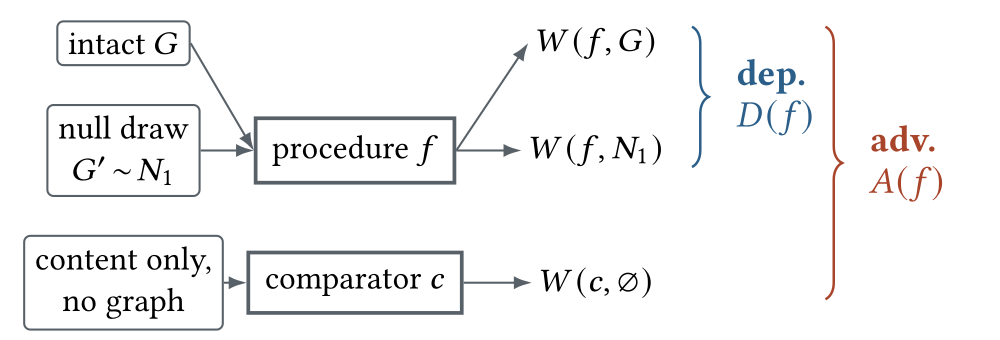
Graph ablation studies often interpret a performance drop after edge randomization as evidence that graph structure improves prediction. These are different comparisons: randomization measures how a fixed procedure depends on the observed edge arrangement, whereas improvement requires comparison with a specified graph-free baseline. Let D = W(f, G) − W(f, N₁) denote dependence on the edge arrangement and A = A(f; c) advantage over a comparator with the same node content and no graph. With survival ratio s = W(f, N₁) / W(f, G), the relative drop is 1 − s.
For an enumerated scorer class, we derive the tightest monotone upper envelope of advantage as a function of this drop and characterize the penalty created by inverted scorer orderings. For scorers whose positive scores require a common neighbor, we also bound null performance using the surviving common-neighbor mass. On ogbl-collab, the 12 arrangement-reading scorers lose between 89.52% and 99.90% of their intact Hits@50 under the degree-preserving null, while their advantages range from −0.3147 to 0.2208. The modularity-matrix spectral scorer loses 91.70% yet has advantage −0.0531 against the content-only comparator; GraphSAGE loses 34.25% and has advantage 0.1423 (95% CI [0.1309, 0.1537]). The same contrasts disagree across five additional public benchmarks.
Finally, we treat a graph null model as a distribution over a constrained graph space and show why the support of its sampling algorithm must be checked separately. The results motivate reporting the intact score, graph-free baseline, survival ratio, and sampler diagnostics together. They concern evaluation validity, not downstream recommendation benefit.
Dependence and advantage
The same intact score is compared with two different reference conditions.
Dependence
D = W(f, G) − W(f, N₁)
How much a fixed graph procedure changes when the observed edge arrangement is replaced by a degree-preserving null.
Observed graph ↔ degree-preserving null
Advantage
A = A(f; c)
How the graph procedure compares with a specified content-only comparator under the same evaluation target.
Graph procedure ↔ content-only comparator
Code and reproducibility
The accompanying code is a small Python package. Its minimal example runs without network access; the paper and public-data example describe their broader protocols separately.
- Source package Typed Python implementation, tests, and package metadata.
- README Installation, public API, paper-to-package map, and scope.
- Network-free example Deterministic JSON report using the public API.
- Paper PDF Searchable paper with the formal definitions and empirical study.
- CITATION.cff Software citation metadata for version 0.1.0.
Citation
Duggireddy, Prahas. “Dependence Is Not Advantage: What Randomizing the Graph Does Not Measure.” Preprint, 2026.
Copy the entry below or download it as a .bib file.
@misc{duggireddy2026dependence,
  author = {Duggireddy, Prahas},
  title = {Dependence Is Not Advantage: What Randomizing the Graph Does Not Measure},
  year = {2026},
  note = {Preprint},
  url = {https://third-wheel.github.io/dependence-is-not-advantage/}
}For software reuse, cite the versioned release and report the version used; see the repository’s CITATION.cff. For the method or results, cite the associated paper.